
City pays tribute to ‘unsung’ Oakwood codebreaker who helped Allies win World War II

Oakwood City Council on Monday paid tribute to one of the city’s “unsung” heroes – Joe Desch, a Dayton native and 17-year Oakwood resident who led American codebreaking efforts during World War II. According to the former Supreme Allied Commander in Europe – and later President – Dwight D. Eisenhower, who led the D-Day invasion, Desch’s work using what were essentially early computers at National Cash Register shortened the war by several years and saved hundreds of thousands of lives on both sides of the conflict. A graduate of the University of Dayton, Desch resided on Greenmount Boulevard in Oakwood while working on the top-secret wartime project.
On Monday, Mayor Bill Duncan proclaimed May “Codebreaker Month” in Oakwood to honor Desch. On hand to accept the honor was Desch’ s daughter, Debbie Anderson of Kettering, and grandson, Joshua Anderson. Last year, retired British Royal Air Force officer and now Oakwood resident Andrew Lloyd and his wife, Cheryl, began championing efforts to recognize the codebreaker and initially proposed naming a city park after Desch, who worked closely and cooperated with famed British codebreaker Alan Turing during the Allied effort to break Nazi naval codes. Lloyd, who had been stationed at Wright-Patterson Air Force Base while in the RAF, said he was familiar with Turing’ s work at the now famous Bletchley Park complex in England, but did not learn of Desch’s own role in Allied codebreaking until coming to Dayton. Turing is known to have visited Desch during the war as the two coordinated Allied codebreaking during the war.
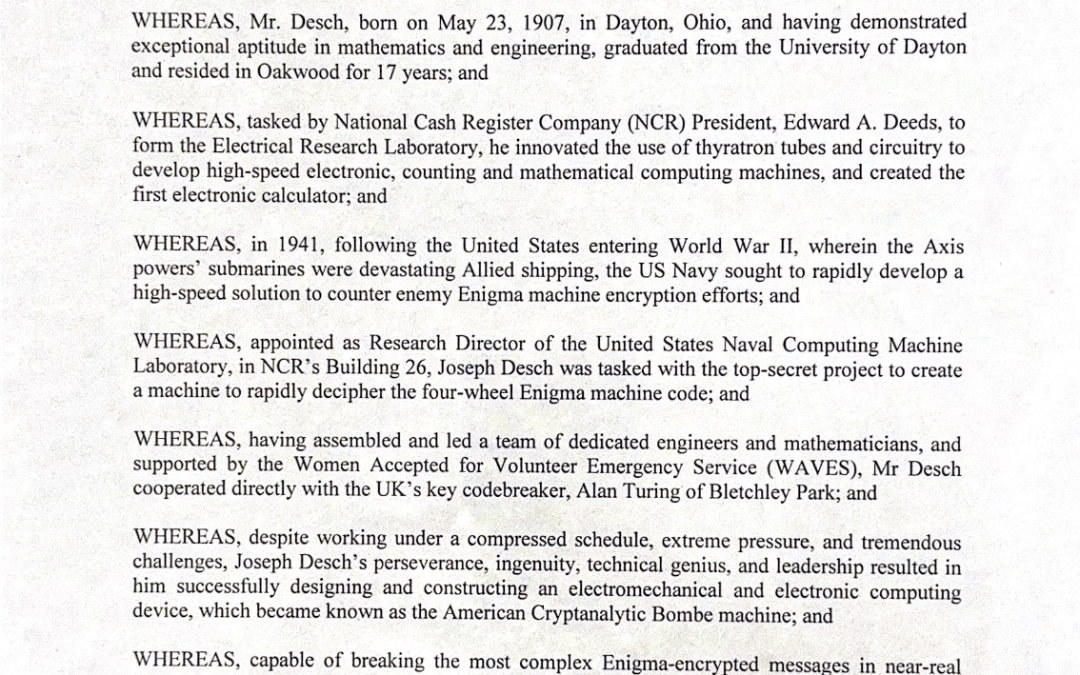
“Joseph Desch, a pioneering and world-leading American engineer and inventor, was awarded the Presidential Medal of Merit in 1947, for his invaluable contributions to the field of cryptography, significantly hastening the Allied victory in World War II,” Duncan noted in his proclamation. “Born May 23, 1907, in Dayton, and having demonstrated exceptional aptitude in mathematics and engineering, Joe Desch graduated from the University of Dayton and resided in Oakwood
for 17 years. Asked by the National Cash Register Company President Edward Deeds to form the Electrical Research Laboratory he developed high-speed electronic calculating and mathematical computing machines and created the first electronic calculator.”
In 1941, as the United States entered World War II, Nazi submarines were devastating Allied shipping along the East Coast and the U.S. Navy tasked Desch was tasked with a top-secret project to rapidly decipher enemy codes. “Assisted by Navy W A VES – Women Accepted for Volunteer Emergency Service, Desch’ s perseverance, ingenuity, genius and leadership resulted in successfully designing and constructing an electro- mechanical device which became known as the American cryptanalytic bombe, capable of deciphering the most complex enigma encrypted messages in near real-time.”
“His accomplishment,” noted Duncan, “is considered the cornerstone of modern automated cryptology. Desch’ s machines provided crucial intelligence and played a major role in winning the Battle of the Atlantic and significantly contributed to the Allied victory, shortened the duration of the war and saved countless military and civilian lives.”
The proclamation, Duncan said, recognizes Desch’ s “unwavering dedication to serving the United States of America, his extraordinary contributions to the field of cryptology, and acknowledges his instrumental role in shaping the outcome of World War II. May his legacy continue to inspire and guide us in our endeavors to advance science, technology and global cooperation for the greater good of humanity.”
“On behalf of the family of Joseph Desch, we are very honored to be here to receive the declaration of Council on behalf of Joe Desch and his team of engineers and specialists at NCR,” Joshua Anderson said. “During the time he resided on Greenmount my grandfather stayed out of the public limelight, necessarily. Today, 78 years later, I’m sure he would be fascinated by the attention the city bestowed upon the work that he performed.”
The Oakwood Register – https://www.oakwoodregister.com/