
Breaking the Enigma Codes
Introduction
The Dayton Codebreakers
Enigma was a sophisticated encryption device utilized by the Germans during World War II. This machine encoded sensitive military communications, posing a significant challenge to Allied intelligence.
As the war escalated, the Brits at Bletchley Park took on the Herculean task of cracking Enigma’s code. Led by Alan Turing, they made significant strides, but the speed at which they could decipher messages fell short of what was needed to effectively impact the war effort.
Meanwhile, German U-boats were wreaking havoc on Allied shipping convoys, sinking countless ships and posing a dire threat to the war effort. The urgency to counter this menace spurred the Allies to expedite their codebreaking efforts.
Recognizing the need for more efficient decryption methods, the British Military reached out to their American counterparts for assistance. The UK’s limited wartime production capacity hindered their ability to scale up codebreaking operations to the required level.
In response, the US Navy awarded the contract to build Bombe machines to the National Cash Register (NCR) Company in Dayton, Ohio. NCR’s reputation for precision engineering and manufacturing excellence made them the ideal choice for the task.
Joseph Desch, an electrical engineer at NCR and Oakwood native, was entrusted with leading the project. His expertise and leadership were instrumental in steering the development and production of the Bombe machines.
As production ramped up, the Women Accepted for Volunteer Emergency Service (WAVES), a division of the US Navy, played a crucial role in building and managing the Bombe machines. These skilled operators worked tirelessly to decipher Enigma messages, contributing significantly to Allied intelligence efforts.
The development of the US Bombe machines in Dayton, Ohio, marked a turning point in the Allied codebreaking efforts, ultimately helping to tip the scales of war in their favor. Toward the end of the conflict, the Bombes’ WAVES operators were reading German and Japanese communications in near real time.
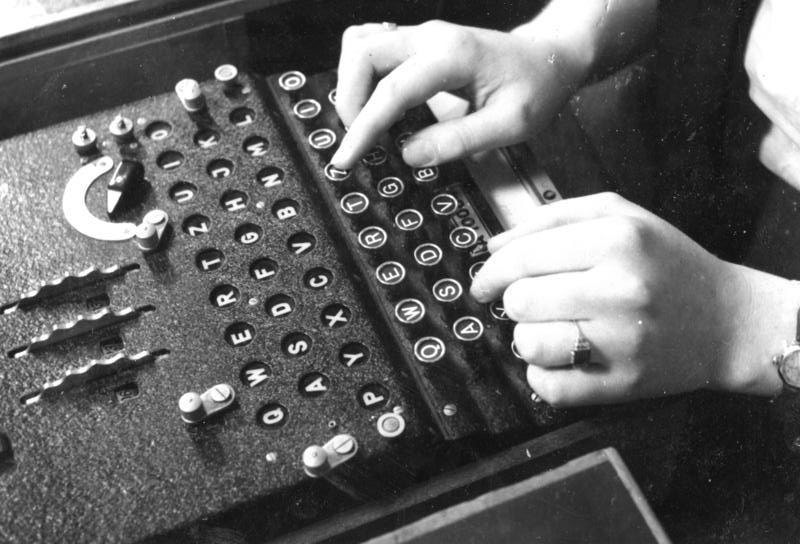
What Was Enigma?
Enigma was a complicated, advanced encryption machine used by the German military during World War II to encode their communications. It consisted of a series of rotors that transformed plaintext messages into ciphertext, making them unreadable without the correct decryption settings.
To encrypt a message, the operator would set the initial positions of the rotors and the plugboard connections according to a daily key. Then, they would type the plaintext message letter by letter. With each keystroke, the electrical current would pass through the rotors and plugboard, producing a ciphertext letter. The settings used to encrypt the message would be communicated separately to the intended recipient.
The operation of the Enigma machine relied on several components:
Rotors: Enigma used a set of rotors, usually three or four, which could be arranged in different orders and positions. Each rotor contained a series of electrical contacts on both its input and output sides.
Plugboard: The plugboard, located at the front of the machine, allowed for further permutation of letters by swapping pairs of them.
Reflector: After passing through the rotors and plugboard, the electrical current would be reflected back through the rotors before reaching the output. This gave each Enigma machine encryption and decryption capabilities, but also a weakness—letters could not be encrypted as themselves.
To decrypt a message, the recipient would need to know the exact settings used by the sender. By inputting the ciphertext into their Enigma machine with the correct settings, they could reverse the encryption process to reveal the original plaintext message.
The strength of Enigma lay in its complexity and the vast number of possible encryption settings, which made it extremely difficult for Allied codebreakers to decipher without access to the daily settings or the machine itself.
Timeline
Contextualizing the Contributions of Joseph Desch and the WAVES
Here is a timeline that outlines the key milestones in the breaking of the Enigma codes, highlighting the contributions of Polish cryptographers, the British team at Bletchley Park, and the eventual American industrial escalation led by Oakwood native, Joseph Desch:
1932-1939
Polish Contribution
1932: Polish cryptologists Marian Rejewski, Jerzy Różycki, and Henryk Zygalski begin analyzing and deciphering the Enigma machine, using theoretical mathematics and a device they developed called the “Bomba.”
Late 1930s: As Germany enhances the security of Enigma machines, the Polish team continues to adapt their techniques.
July 1939: Just before World War II, recognizing the impending threat of invasion, Polish intelligence shares their Enigma decryption techniques and findings with British and French intelligence.
1939-1941
Initial British Efforts
September 1939: The British Government Code and Cypher School (GC&CS) at Bletchley Park, led by Alan Turing and others, begins work on Enigma, building upon the Polish groundwork.
1940: Turing develops the British Bombe, an electromechanical device to automate the decryption of Enigma-encrypted messages. The British Bombes are successful but face limitations in speed and scalability.
1942
Scaling Challenges and U.S. Involvement
February 1942: The Germans add a fourth rotor to their naval Enigma machines, significantly increasing the complexity and the number of possible settings, exacerbating the challenges for the existing Bombe machines and necessitating vastly increased decryption capabilities.
1942: The U.S. Navy, recognizing the need for greater decryption capacity to keep up with the war’s demands and the new complexities introduced by the four-rotor Enigma machines, turns to American industry for a solution.
1942-1943
American Industrial Mobilization
Joseph Desch at NCR in Dayton, Ohio, is commissioned by the U.S. Navy to design a more efficient and faster version of the Bombe, capable of handling the increased permutations caused by the fourth rotor.
1943: Under Desch’s leadership, NCR begins large-scale production of the U.S. Navy Bombes. These machines incorporated several improvements over the British versions, such as automatic error correction and the capability to reset quickly for new runs.
WAVES Involvement: The Women Accepted for Volunteer Emergency Service (WAVES) played a pivotal role in both assembling these machines and operating them throughout the war, markedly enhancing the wartime cryptanalysis efforts.
1943-1945
Impact on the War
1943 onwards: The American-built Bombes, with extensive operational support from WAVES, were deployed widely, boosting the Allied ability to intercept and decrypt Axis communications through the end of World War II.
The Foundation of International
Intelligence Cooperation
The development of the U.S. Bombe during World War II marked a significant milestone in the history of international intelligence cooperation, particularly between the United States and the United Kingdom.
The exchange of technology, expertise, and cryptographic advancements between the U.S. and the UK, exemplified by the mass production and deployment of the U.S. Bombe, laid the groundwork for the post-war UKUSA Agreement in 1946.
This agreement initially between the UK and the USA, soon expanded to include Canada, Australia, and New Zealand, forming the Five Eyes alliance. This intelligence-sharing pact, born from the effective wartime cooperation and the mutual recognition of the strategic benefits of shared intelligence, has evolved into one of the most enduring and comprehensive intelligence alliances in the world.
Stay tuned and come back soon!
We’re continually working to bring you more fascinating information about Joseph Desch, the WAVES and Oakwood’s groundbreaking contributions to technology and World War II efforts.
Thank you for your patience and interest!